How Google Review Count, Velocity, Recency, and Average Rating Affect Your SEO and Credibility
Given Google’s importance in driving customers to your business, very few business owners doubt the influence and impact reviews have on both your online visibility and credibility in customers’ eyes.
However, simply having reviews is not enough for your reputation to thrive within search engines or in the minds of your potential customers.
In this article, we examine several different factors as they relate to collecting Google reviews: recency, velocity, average rating, and comparative review count. We break down these review elements and why you should be prioritizing each one. Note that this research focuses exclusively on reviews collected on Google Business Profiles. Other review platforms, such as Yelp and Facebook, may have some similarities but are not explicitly discussed or analyzed within this article.

Our conclusions in this article come from a mix of our experience helping small business clients with SEO since 2012, operating a review management service which has collected thousands of reviews, working with Google support and product experts, and validating third-party studies from reputable companies like Whitespark and Sterling Sky.
Table of Contents
Google Review Recency
Review recency considers the date of the last Google review your business received and how many days have passed since that review was posted.
Google significantly rewards Google Business Profiles that have very recent reviews, especially when compared to competitors within the same industry.
Multiple studies by world-renowned local SEO company, Sterling Sky, and SEO tool creator and SEO provider, Whitespark have confirmed review recency has an impact on rankings.
In fact, if you want to see a quick jump in your local search engine rankings, earning a recent customer review can do just that. Check out the video by Whitespark below that shows Google review recency in action.
Beyond rankings, though, do you want your customers to be greeted by a review that’s 18 months old, or a review within the last couple of weeks? One certainly screams more relevance and credibility than the other. Additionally, Google will even put a “New” tag on reviews that are relatively recent.
Google Review Velocity
Your review collection process should focus on consistently getting a steady stream of new reviews in the door. Google rewards either a relatively steady or increasing velocity of reviews for legitimate businesses.
Google has automated review filtering systems in place that can be triggered and filter out your reviews if they see a sudden, suspicious spike in reviews. These systems exist to combat and filter out fake reviews, reviews that were purchased, or even malicious negative review attacks.
Additionally, it can look sketchy to your customers if a notable chunk of your reviews all were posted on a few select days.
Similarly, businesses experiencing a declining velocity of reviews sends a signal to Google and potential customers that your business is decreasing in popularity or relevance.
As such, it is critical to have an even flow of Google reviews coming in the door. Asking your customers for reviews should be a routine part of your post-sale and customer service processes.
Average Star Rating
The average star rating on your Google Business Profile can have a notable impact on consumer trust and your appearance within search engines.
Google states that it wants to “…deliver the most relevant and reliable information available.” As such, Google has an incentive to show businesses that are most likely to satisfy the customer’s search.
Of course, Google will certainly still show low-rated businesses. However, we do believe Google and other search engines favor relevant businesses with a higher star rating if it is also in conjunction with other factors like recency, velocity, and review count.
Keyword Filters for Google Review Rating
That said, there are certain keyword filters like "best" or "top" that, when used in conjunction with a search, will trigger Google to show businesses with higher ratings first (typically with a relative minimum rating floor).
You can see in the example below the results change due to the addition of the keyword "best" to the search query.
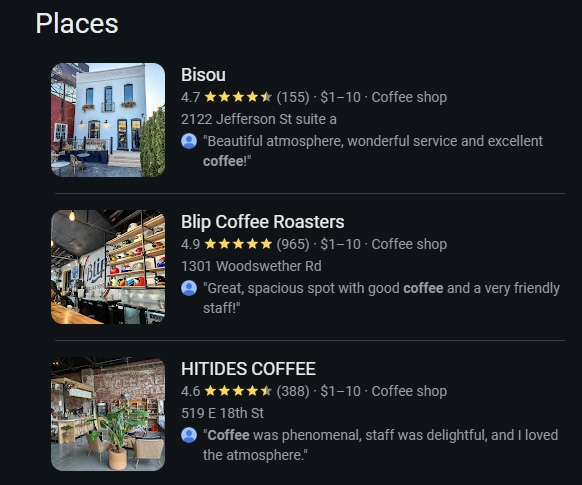 Google search results for "coffee shops kansas city"
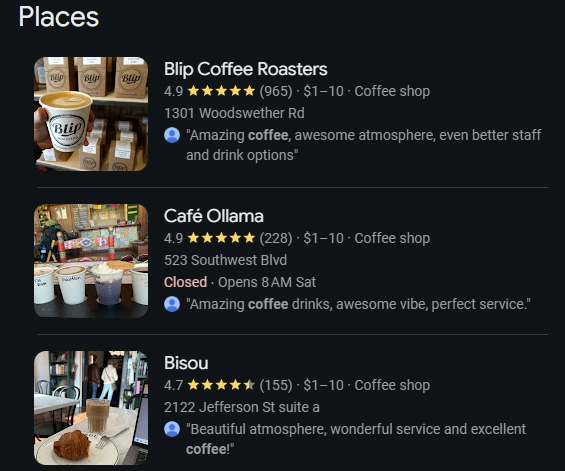 Google search results for "best coffee shops kansas city"
You can test this for yourself.
Perform a Google search like “coffee shops kansas city,” then compare those results to “best coffee shops kansas city.” You’ll notice the order of results within the Google local pack and local finder change. Additionally, you’ll notice that you are seeing less variance within the star rating as an average rating floor is applied.
What Is a Good Average Rating?
A “good” average rating is relative to your industry and competitors. For example, ISPs (internet service providers) typically have a notoriously low average rating. Naturally, when an internet outage occurs, this leads to a massive increase in negative reviews, even if their internet uptime was 99.999%. The 0.001% downtime is enough to bring down their average review rating, especially if you were binging your favorite TV show.
For example, I used Google Fiber for nearly a decade both at home and the Igniting Business office, and even though their closest office has a 3.8-star average rating, I can 100% say they deserve five stars in my book based on reliability and price.
On the other hand, I’m probably not going to visit a 3.8 star steakhouse, nor do I want a 3.8 star haircut.
To summarize, you should exceed the average star rating of your competitors by focusing on delivering the best customer experience possible.
Is a Perfect 5.0 Star Rating Actually Good for Business?
I’ve heard so many of our clients stress out about achieving the perfect 5.0 star rating. However, we’ve also seen where potential customers are leery of businesses with a perfect 5.0 star rating, believing that it’s too good to be true and the company may have purchased reviews or manipulated its reviews somehow.
As such, we encourage our clients to deliver the best service they can absolutely provide and be quick to fix mistakes when they happen.
If you’re hitting an average rating of 4.5–4.9, you’re doing fantastic! Don’t worry about getting a perfect 5.0, as customers might trust a 4.9 more!
Yes, as over a dozen people have pointed out, I realize the irony that Igniting Business has a 5.0 rating. If you want to go leave Igniting Business a 4.0 star rating to help my case, please be my guest. 😉
Comparative Review Count
We often get asked by our clients if there is a specific number of reviews they should try to achieve. The ideal review count is an always-moving target and is based on your competitors and industry.
For example, it’s going to be much easier for a restaurant to get more reviews than a custom home builder purely based on the number of customers they manage on a daily basis.
Google certainly rewards Google Business Profiles that have a higher review count. However, having a higher number of reviews is not the only, or most important, factor. You should definitely be prioritizing review velocity, recency, and average star rating.
If you absolutely need to calculate a number for your boss’ SMART goal initiative, take a look at your top competitors and shoot for earning 20% more reviews than them as a starting point.
That said, there are definitely rewards from Google when you hit certain numbers of reviews.
Review Thresholds
Through testing and tracking, Sterling Sky identified that when a business hits an initial 10 reviews, there is a notable rankings boost, but diminishing returns at higher review counts.
At Igniting Business, we believe there are at least two additional rankings boosts that occur at much higher thresholds.
Additionally, having significantly more reviews than your competitors can help offset Google’s proximity bias by increasing your business’ overall prominence. In other words, Google will be more likely to show your business to searchers located further away from your business’s physical location as your comparative review count increases.
Owner Review Response Rate Signals Operational Health
As you may know, managers and owners of your Google Business Profile have the ability to respond to customer reviews publicly. Keep in mind that the review response will show up as a response from the business "owner."

We believe Google monitors both how fast businesses respond to new reviews and what percentage of reviews have an owner response.
While neither of the above are confirmed ranking factors, we believe review response speed and response percentage may act a signal of operational health and completeness of your Google Business Profile. More importantly, timely review responses to every review are simply quality customer service.
As such, we strongly believe that you must respond to every online review about your company.
How to Increase Your Google Review Count, Rating, and velocity
To recap, you must increase your comparative review count, overall average rating, velocity of reviews, and review recency.
To do this, we recommend integrating the practice of collecting reviews into your customer service experience. Make asking for reviews (both positive and negative) a part of your day-to-day practice. Also, we recommend referencing our guide on who you can ask to write a Google review.
If you want to make review collection more effective and efficient, use a reputation management system that sends out review requests and reminders to your customers via email or SMS.
Igniting Business has a reputation management system that does this for our SEO and digital marketing clients. However, if you’re looking for a standalone reputation management system, Whitespark has an affordable reputation builder toolset that’s just as good as ours.
If you’re looking for more tips on review collection, reputation management, or SEO, consider subscribing to our free monthly newsletter.
At no additional cost to you, we may receive a commission if you click on some of the links on this website and make a purchase.